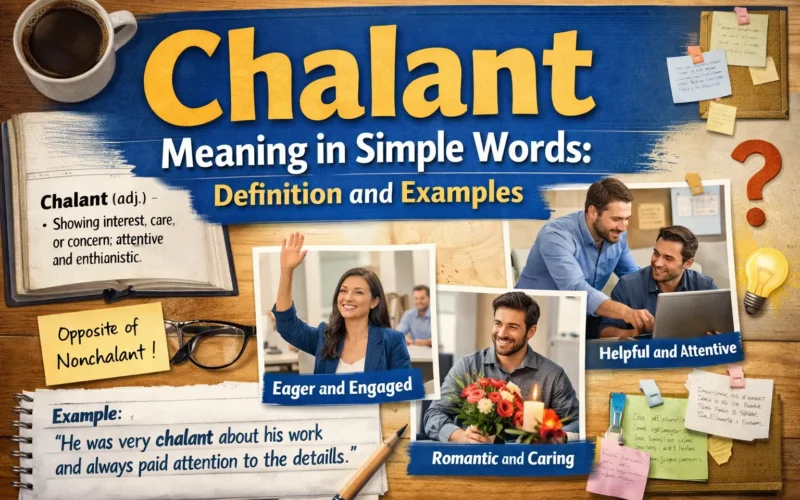
Have you come across memes, social media posts, or chats where someone writes something like, “I’m very chalant about this.” The sentence sounds natural but reality is something different as you think. People start wondering what is chalant meaning and is it actually a real word in the English language? If you are one of those who is curious about knowing whether this word has a meaning as per English dictionary or not, then you have reached the right platform. Here we are going to discuss what chalant means. In addition to this you will also find information on nonchalant vs chalant meaning.
What is Chalant Meaning?
According to social media the word chalant means someone who is attentive, concerned, or emotionally involved in a situation. This word is also used by people as an opposite of nonchalant. Nonchalant describes someone who is appearing calm, relaxed and unconcerned. Whereas chalant describes someone attentive, concerned, or emotionally involved. So when someone asks what is chalant meaning, the simple explanation is; it describes a person who cares or reacts strongly instead of acting cool or indifferent. Most language experts point out that chalant mean is not widely recognised as per a standard English word. Instead it is considered an informal or playful expression created by speakers.
The Origin Behind Nonchalant Vs Chalant
| Aspect | Nonchalant | Chalant |
| Origin | Borrowed from French | Created later in English by speakers |
| Root Word | French verb “chaloir” (to care or be concerned) | Derived by removing the prefix “non” from nonchalant |
| Original Meaning | Not caring, calm, unconcerned | Used to mean caring, attentive, or emotionally involved |
| Dictionary Status | Recognized and widely accepted English word | Informal or playful word; not widely accepted in major dictionaries |
| Usage | Common in formal and informal writing | Mostly used in casual speech, chats, memes, and social media |
| Example | “She stayed nonchalant during the stressful meeting.” | “I’m very chalant about the exam results.” |
| Linguistic Type | Standard borrowed word | Back-formation created by language users |
| Popularity | Long-established in English | Gaining popularity online in recent years |
Dictionary Recognition Of Chalant
The question about chalant meaning often leads to dictionary discussion. Some online dictionary and language resources mention, chalanting definition as a humorous or informal term meaning “showing concern” or “not nonchalant.” major traditional dictionaries generally do not treat it as a fully standard word. This word is often labelled as informal, playful or rare when it comes to language references. Yes this word is very popularly used by people but does not exist in discussion and usage. In other words we can say that this word is not widely accepted by people in formal English writing.
Some Examples Of Chalant Use In Everyday Life
Chalant meaning has become very popular in communication despite its unofficial status. People often use the word ‘Chalant’ on social media, messaging apps and casual conversation. The word used in following ways:
- “I’m very chalant about this meeting tomorrow.”
- “Don’t act cool, I know you’re chalant about the results.”
- “He tries to be calm, but he’s actually very chalant.”
In these sentences, the chalant mean clearly suggests emotional involvement, concern, or nervous attention. People understand it instantly because they already know the meaning of nonchalant.
Chalant Meaning Explained With Example
You will able to understand this concept very easily with a simple situation specified here:
Suppose two students are waiting for their exam results.
Student 1: “I am totally nonchalant”, they appeared relaxed and unconcerned.
Student 2: “I am very chalant”, the listener imagines someone checking their phone constantly feeling anxious and caring deeply about the outcome.
This emotional constant explain why nonchalant vs chalant works so well in everyday uses
Chalant Meaning As Per Social Media
The rise of digital communication has played a major role in spreading chalant meaning. On platforms like WhatsApp, Twitter, Instagram short forms and expressive languages are encouraged by people and often used also. For example an Instagram caption might say “Trying to act calm, but very chalant inside.” These types of posts resonate with people because they express real emotions. Instead of pretending to be relaxed the word challenge openly admit concern or excitement.
FAQs
What is chalant meaning in simple words?
It simply means someone who is attentive, concerned, or emotionally involved, often used as the opposite of nonchalant.
Is it actually a word in the real English language?
According to some sources it is an informal word and not a word in real English language.
Should you use chalant in writing?
If you are writing an academic paper or professional email or formal report then you should not use the word ‘chalant’ as it is not fully accepted in standard English. But if you are chatting on social media or writing captions or doing informal conversation then you can use this word.
Why is chalant continuously gaining popularity?
It is gaining popularity because chalant meaning shows how people naturally experiment with words.
What is the chalanting definition?
The challenging definition generally refers to showing interest, concern or engagement instead of acting differently.